I love word games. My favourite type is word scramble, or anything where you find words from random letters – like Boggle, but on paper. I particularly enjoy the challenge of trying to unscramble all the letters to find the nine-letter word.
Word scramble games were one of the therapies I prescribed myself while recovering from brain surgery to remove a tumour and a second operation six months later, when the swelling in my brain had resolved, to repair my skull. Even though my neurosurgeon advised me that left-handers don’t store their everyday words in their speech and language centres (where the tumour was located), it turns out that’s where I keep what I call ‘higher value’ words (like justification and striation) and my spelling ability.
I have always been an intuitive speller. I could look at a word and know it was wrong. To find out how to spell it correctly, I would write a few different versions, and the right one would stand out. I just KNEW how the word was spelled. But, after my surgeries, that wasn’t the case anymore.
It is hard to get people to understand how awful it was for me to discover I had lost a natural ability that had been with me since I started learning to write words. It was something I took for granted – like walking. To have always had a certain type of knowledge without thinking about it and then suddenly lose it was horrible. Not only could I not determine if a word was right or wrong, but I couldn’t work out what sound combinations would make the word I wanted to use. The word Squawk particularly bothered me. Skwark? Squark? Squaurk? Nothing I wrote looked right. To find out how to spell it, I typed ‘sound a bird makes’ into Google, which supplied me with the correct spelling. Then, I used the word as often as I could. Thankfully, Word’s spellcheck alerted me when I mistyped something, so I knew something had to change, but it took a long time to cement that word into my brain again.
To those who don’t write regularly, losing this skill probably wouldn’t seem like much. After all, I’m alive. I can talk. I can understand conversations. I can read. I can still write, even if it takes longer to find the exact word I’m searching for. Some people wake from brain surgery unable to do many of those skills. But, as a Special Needs Education Assistant in a primary school, where marking spelling lists is a regular task, it was a challenge. I couldn’t hold words in my head long enough to not need to put a marking key against every single word on the lists. It slowed me down. It frustrated me that I was having difficulty marking spelling words from Grade 3 to Grade 6. The teachers understood and were patient, but my biggest critic has always been myself. It grated that I couldn’t do what I used to do.
It has been seven years since my second surgery (six months after the first, to seal the hole left in my skull). At first, while playing word games, I had to content myself with finding small words and hope to eventually improve enough to untangle larger ones. When I encountered a word that wouldn’t come out from wherever my brain stored it, I would ask someone what word belonged in that space. Over time, I improved in my ability to hold words in my head, to remember which words belonged to which meaning (e.g., when people say one thing and mean another is ‘agenda’), and to be able to write without leaving dots for the words I couldn’t retrieve, in the hope they would come back later when I wasn’t trying so hard to find them. I had to learn patience and accept that maybe some things were gone forever. I consoled myself regularly with the fact that I was still here, still able to enjoy time with my family, and could still read and comprehend even though the more tired I got, the less able I was to communicate effectively in speech and writing.
And, somewhere along the way, I became a writer again. My friends will tell you I practised for years with my Facebook updates! But, more intentionally, in 2022, I started with submitting 50-word snippets for 50 Give or Take. I was delighted when one of my entries was accepted, with the suggestion of changing one word. I sent more and was thrilled when another four micro-fiction stories were approved for inclusion. In early 2023, I submitted short stories and poems for an anthology called The Voice in the Paint. That progressed to ‘Brush Tales; Silent Stories’, released two weeks ago (available for purchase here: Brush Tales: Silent Stories : Manzo, Wendy, Bock, Natalie: Amazon.com.au: Books). Being recognised as a capable author was exciting and certainly not where I thought I’d be after two brain surgeries. But almost equally incredible is what happened yesterday.
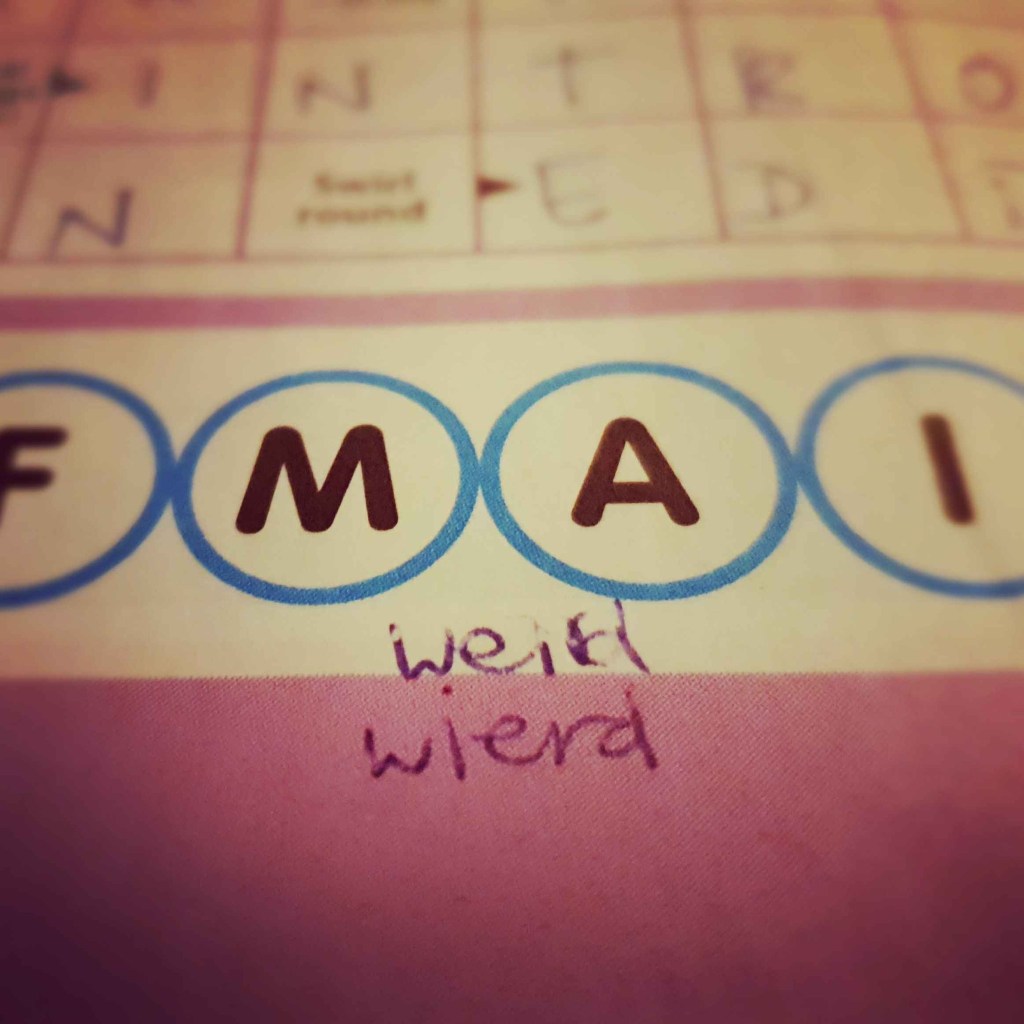
I was doing a word puzzle, old school style, with pen and paper. Nine jumbled letters containing a W, an E, an R, one I and a D. My brain worked out ‘weird’. Then, I asked myself whether it was IE or EI. I know the rule is ‘I before E except after C’ – unless it’s one of the many exceptions. Out of habit, I wrote both words. First, I wrote WEIRD. Then I started writing WIER… and before I had even finished, I just knew it was the first way.
I.
JUST.
KNEW!
I can’t describe the excitement that flooded my entire being. I knew. I could see the difference. That thing I did without thinking for years – until I couldn’t – had come BACK. At least for that word. Even if it was just that word where I could tell the correct spelling, the relief and delight of doing something that I used to be able to do was exhilarating.
Some people find delight in travelling the world and engaging with its wonders. Others chase down the endorphin high created by intense exercise. Me? I’m thrilled to bits to be able to tell the difference between a wrongly spelled word and a correct one just by writing them both down!


Response to “PLAYING GAMES”
I love this, Natalie!
A kindred spirit (Gweneth)
xx
LikeLike