This week, I wanted to share some of my on-the-spot writing. Once a month, I attend a local creative writing group. The facilitator introduces a concept and then gets us to write along the lines of that style or idea. At least, that’s her plan. This month’s session didn’t quite turn out the way she intended because many of us – and especially me – didn’t understand what to do. I know that because she laughed and said every single one of us looked confused.
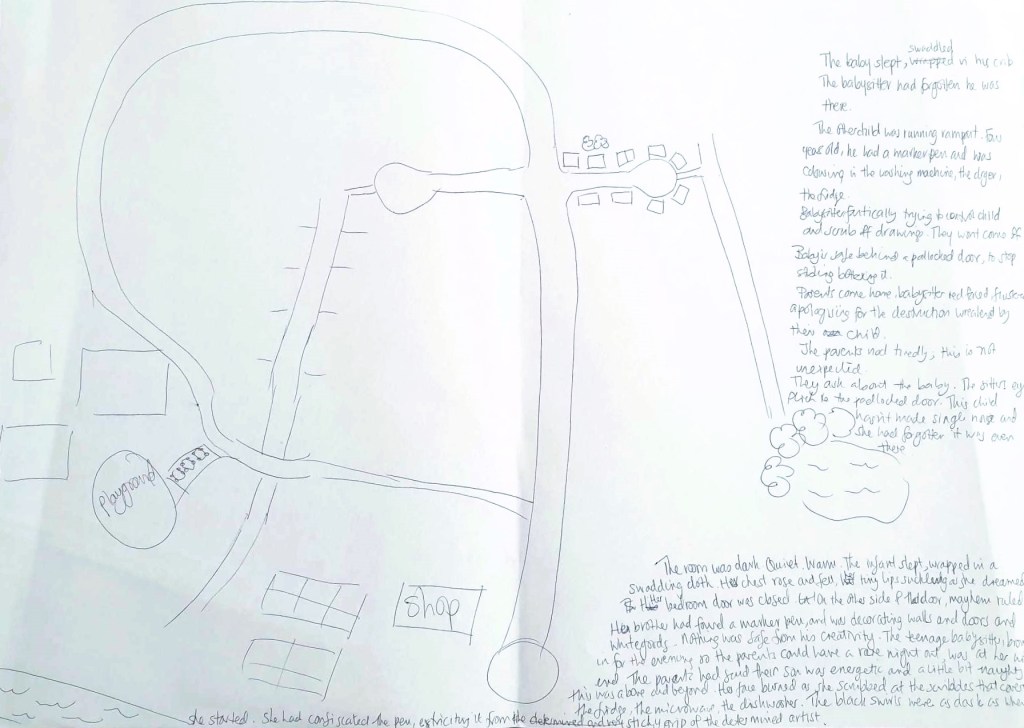
The idea was to write a plot. The facilitator explained the difference between a plot and a story. One involves timelines and sequential order, and the other answers the why. Or something like that. That part almost made sense. What threw me was the piece of paper we were given and the instructions to draw our childhood home and then expand out to our streets and larger neighbourhood. At the same time, we were to add trees and other items that we remember being along the streets or near those homes. BUT, the story wasn’t necessarily about our childhood. It could be inspired by what we thought happened on those streets or in those homes.
Yet, for me, as soon as I started drawing my childhood home, stories came to mind. Stories I wanted to tell. Stories of sleek black cars bearing royalty along red-dirt-edged roads. Of crossing dry creek beds to get to school. Of pulling glass from my bare foot and then trying to put it back in so that I had something to make people give me attention and sympathy.
The problem with any of those stories is that I couldn’t remember enough details of those streets. I was nearly seven when we left that tiny, salt-lake-edged desert town, and my memories are as misty as the heat haze that constantly shimmered above the ground, giving everything a dreamlike quality.
So, I changed towns to the one I lived in from the age of seven until I left home at seventeen. I walked and rode those streets often enough that the map was seared into my mind. I drew the cul-de-sac where we lived, added the houses, marked down the lane that led to the open area behind the houses and the dirt track that took us to the paperbark tree grove. I sketched in the school, the playground, the creek behind it where we caught gilgies (said joogies) and a friend tricked me into drinking the water. I showed the walkway connecting the cul-de-saced streets to an open space that all the children poured themselves onto every day to get to school without having to cross a road. And as I drew the sites and considered the surroundings, another story threw itself into my head. Within thirty minutes, 500 words had found their way onto my page. Here they are, unchanged from the way they presented themselves to me in that time frame:
PLOT A STORY BASED ON CHILDHOOD SURROUNDS
The room was dark. Quiet. Warm. The infant slept, wrapped firmly in a swaddling cloth. Its chest rose and fell, little lips suckling as it dreamt. Beyond its crib, the bedroom door was closed. On the other side of the door, mayhem ruled.
The baby’s brother had found a marker pen and was decorating walls and doors and white goods. Nothing was safe from his creativity.
The teenage babysitter, brought in for the evening so the parents could enjoy a rare night out, was at her wit’s end. The parents had said their son was energetic and a little bit naughty, but this was above and beyond. Her face burned as she scrubbed frantically at the scribbles that covered the fridge, the microwave, the dishwasher. The black swirls were as dark as when she started. She had confiscated the marker, extricating it from the sweaty, sticky grip of the determined artist, but there was no way she could hide the damage he had created.
Somehow while she had been cleaning, the boy had fallen asleep, sprawled out on the lounge where she had envisaged spending a quiet night watching TV while two sweet children slept. The babysitter scooped up the sleeping child and carried him to his ransacked room. She placed him neatly in his bed and pulled up his covers. Deeply asleep, he looked like an angel, not the terrorist she had been struggling with for the last two hours.
As the babysitter returned to the front room, light beamed through the windows. A quick swipe at the curtains revealed the headlights of an approaching car. Footsteps sounded along the side of the house. Her heart thumped as the front door handle turned and the heavy wooden door opened.
Two happy parents stepped into the house, smiling and laughing after what was clearly a good night away from their children.
Red-faced and obviously flustered, the teenager apologised for the destroyed white goods. The parents nodded, not surprised at the destructive tendencies of their firstborn. Then they asked how the baby had been.
The furtive flick of her eyes to the padlocked door gave the babysitter away. She had forgotten the baby was even there, safely locked into its room so its brother could not gain access. She hoped the lack of sound meant the baby was still sleeping, safe in its swaddle.
Taking the key from its hook high on the wall where their son could not reach it even when standing on a chair, the father unlocked the padlock and slid back the latch. Slowly, gently, he opened the door and stepped inside. Placing his hand on the infant’s chest, he felt its steady breath. Satisfied the baby had come to no harm, he returned to the front room, where his wife and the babysitter still stood.
Silently, he paid the teenager the agreed sum for her services. They never asked her to watch their children again.
The babysitter was pleased because she would have said, “No”. This had been both her first gig and her last.
THE END.
It turns out I’d written a story, not a plot. I didn’t mind. I received enough specific feedback to understand the difference was that a plot would have started in a point of action (such as the father unlocking the room and resting his hand on the baby to check it was still alive) and then gone back to tell the tale from the beginning, moving through the action and arriving at the conclusion. Either way, the same story would have been told, but the arrangement and dramatic placement would be different. I learned what a plot was. I released a story from my mind. I left satisfied with my achievements.
And… yes.
The story is true.
 A Glorious Mess