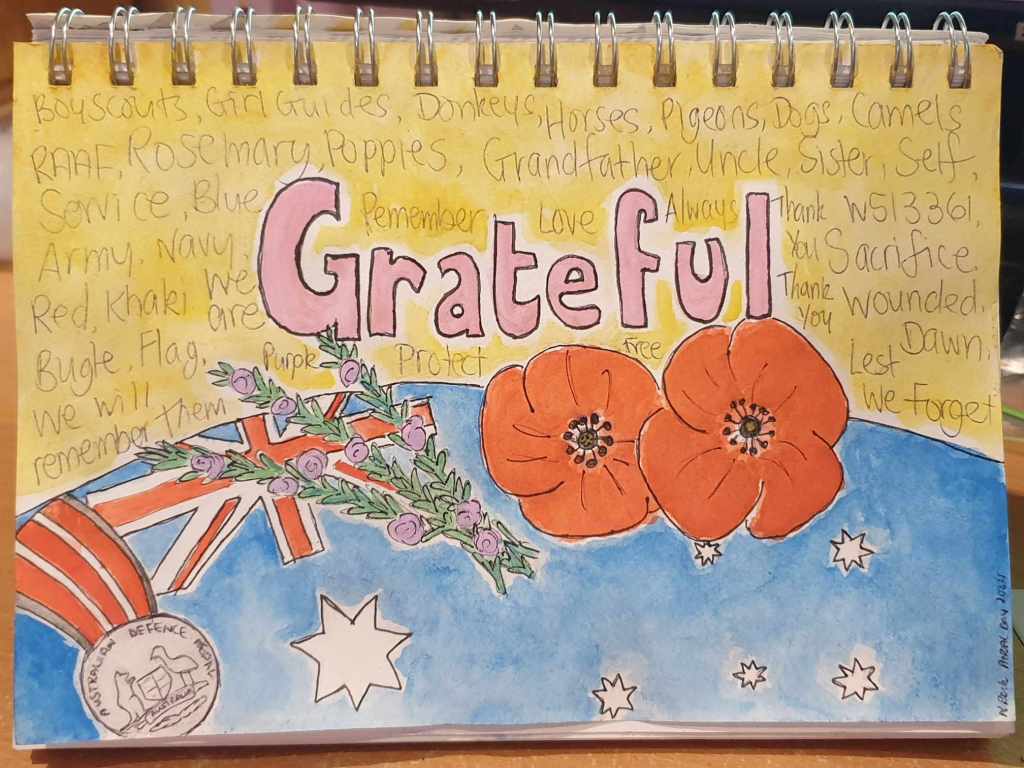
I am not a gifted artist. Nor a skilled one. That’s probably evident in the image of the artwork in this post, which I drew and painted. It depicts two poppies, some sprigs of rosemary, and a Defence Service medal on the Australian flag. The background of words connected to ANZAC Day is overwritten with the phrase ‘Grateful’ in my closest approximation of hot pink, which is what Google tells me is the colour of gratefulness.
I am not showing you my work to get feedback on my potential. Neither am I not looking for a critique of my art. It has good points and flaws, and I accept that.
I am showing you this piece of art because I have spent all of Anzac Day painting it. I am slow at using watercolours. I don’t have a great sense of colour mixing. I don’t know how to make light and shade with paint instead of words. But, as I drew and painted, I reflected on what today means.
I am the daughter of a sailor. The granddaughter of a digger. The niece of an Air Force man. My sister followed our father into the Navy. I joined the same service as my uncle, not knowing at that point of his existence, and signed over six and a half years of my life to our country. The benefits and the disadvantages of serving have impacted us all.
Yesterday, I stood in front of an ANZAC memorial at the school where I used to work and laid flowers. Every year, my old school does a beautiful, touching commemoration for Anzac Day, and I was honoured to be invited back as a veteran and special guest.
The memorial I paid my respects at consists of a rusted silhouette of soldiers mounted between and slightly back from the two flagpoles bearing the Australian and Indigenous flags and behind four large mosaiced tiles depicting poppies, which the school children helped make in their art classes. Slightly up the slope on which the silhouettes are embedded is a garden containing rosemary as a nod to the herb that grew wild around the hills of Gallipoli.
The children at the school see this memorial every day as they work and play. The acknowledgement of war and loss is part of their everyday lives. They attend the ANZAC service every year and know how important it is. And so they sat and listened for the entire hour of the service. Over four hundred students aged five to twelve were in the assembly area. There was the occasional wriggle and squiggle and a quick trip to the toilet for a few of the smaller ones, but their overall behaviour was exemplary.
Supported by the school choir, they sang Waltzing Matilda, I am Australian, and both the Australian and New Zealand national anthems (in Māori and English). They respected the one-minute silence. They knew the response to ‘We will remember them’. They were fascinated by the horses saddled with empty boots placed backward in their stirrups to represent the riders who didn’t come home from war.
They listened attentively to the Army lieutenant in full Light Horse Regiment uniform, complete with ostrich feathered slouch hat, who gave the key speech. She told them clearly that war is not something to look forward to. It is not something to idolise. She insisted that she is no hero – that title belongs to those who never came home or died from wounds received in war. She made it very clear in a way that the children (and the parents listening) could understand that war is awful, death is forever, and we should hope to never be in that place again.
The entire commemoration was a fitting and thoughtful tribute to all people involved in wars. And so, inspired, today I sat and created my own tribute while thinking about the impact of war on my extended family.
I thought of as many symbols and services to represent the history of ANZAC Day as I could. I know I haven’t included the medical staff who fought their own battle to save those injured in the fighting. I had already written most of the words in biro and couldn’t find a place to fit them in that didn’t make it look like an afterthought, which I thought would be more of an insult than not including it. Like I said, my work has flaws.
But mostly, my work is an offering to the memory of everyone affected by war. To my family. To those whose families were forever disrupted by loss and injury and the ravages of post-traumatic stress disorder that back then didn’t have a name and wasn’t well understood. I gave up a day to create my work – they gave their lives.
While war is sometimes necessary, it is not glorious. Its consequences are long lasting and deep reaching. On ANZAC Day, we commemorate bravery and sacrifice and loss without celebrating its cause.
Lest we forget.
 A Glorious Mess